> ## Documentation Index
> Fetch the complete documentation index at: https://docs.galadriel.com/llms.txt
> Use this file to discover all available pages before exploring further.
# How TEE works
> TEE (Trusted Execution Enclave) proves that a given code is running as expected
The whole source code is available
[here](https://github.com/galadriel-ai/sentience)
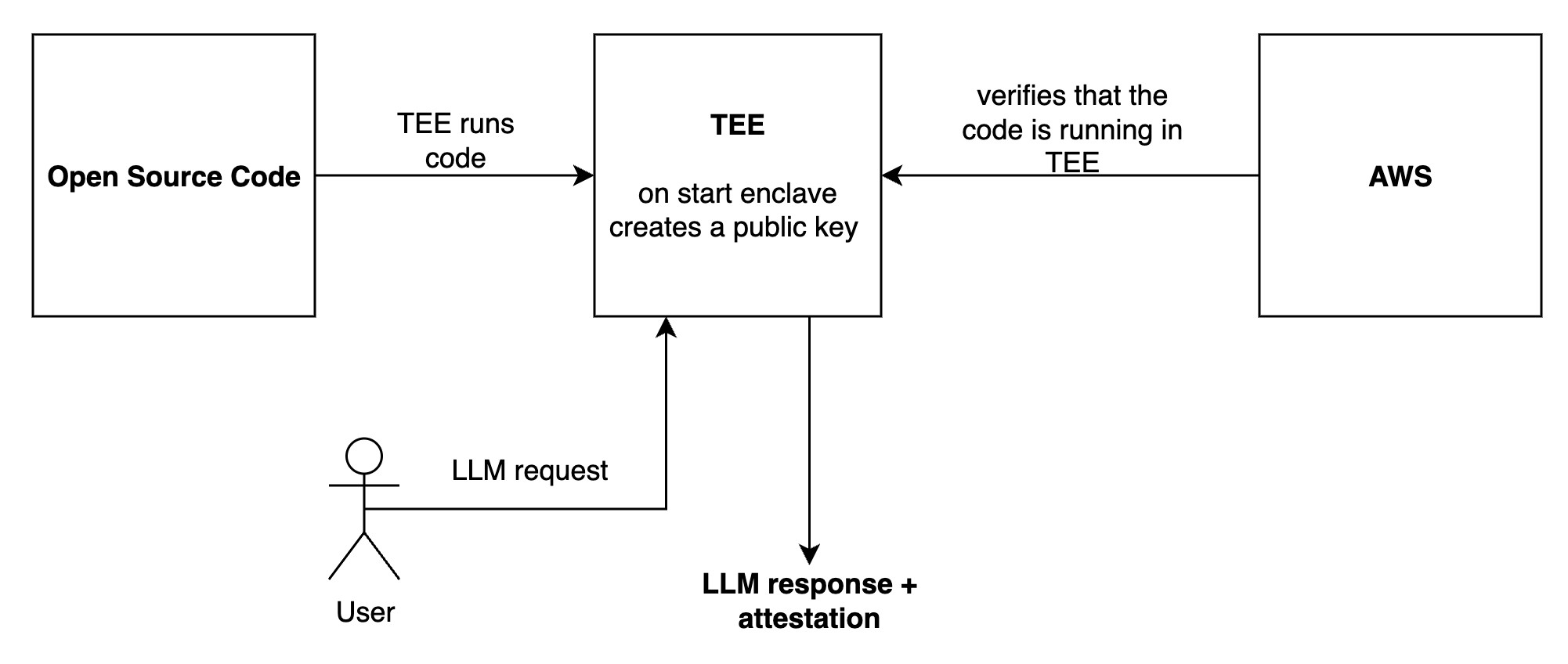 The Sentience enclave
[code](https://github.com/galadriel-ai/sentience/tree/main/enclave) is
first packaged into a Docker image, which
is then packaged into an enclave image. This is a deterministic process:
the resulting `enclave image hash` verifies that the code running inside
the TEE (Trusted Execution Environment) is indeed the original code.
To confirm which code is running in the TEE, take the source code and
generate a new enclave image. If you end up with the same `enclave image
hash`, you have verified that it matches the code currently running
inside the TEE.
Upon TEE startup, a private key is generated. Since no one can access
the internal components of the TEE, any data signed with this key can be
trusted as authentic.
AWS signs the resulting enclave image hash alongside the generated
public key inside the TEE. This signature provides a final guarantee
that the code is running exactly as intended, without any
intermediaries.
You can read more about Nitro Enclaves
[here](https://docs.aws.amazon.com/enclaves/latest/user/nitro-enclave.html)
Each LLM inference request to the Galadriel Verified API is processed in
the enclave. After the LLM generates a response, both the request and
the response are hashed using SHA256. This hash is provided in the LLM
response under the `hash` field.
The hash is then signed with the TEE’s private key, producing the
`signature` field.
Finally, the Galadriel API includes the full `attestation` and `public_key`
in the LLM response. With these four pieces of information: `hash`,
`signature`, `attestation`, and `public_key` you can verify that an LLM
inference genuinely took place inside the enclave.
### What's next?
* To see more details about the API check out the full [API docs](/api-reference/proof-of-sentience-API)
* To see how to verify the signatures [Verify Signatures](/for-agents-developers/verify-signatures)
* To see how to verify the attestation [Verify Attestation](/for-agents-developers/verify-attestation)
The Sentience enclave
[code](https://github.com/galadriel-ai/sentience/tree/main/enclave) is
first packaged into a Docker image, which
is then packaged into an enclave image. This is a deterministic process:
the resulting `enclave image hash` verifies that the code running inside
the TEE (Trusted Execution Environment) is indeed the original code.
To confirm which code is running in the TEE, take the source code and
generate a new enclave image. If you end up with the same `enclave image
hash`, you have verified that it matches the code currently running
inside the TEE.
Upon TEE startup, a private key is generated. Since no one can access
the internal components of the TEE, any data signed with this key can be
trusted as authentic.
AWS signs the resulting enclave image hash alongside the generated
public key inside the TEE. This signature provides a final guarantee
that the code is running exactly as intended, without any
intermediaries.
You can read more about Nitro Enclaves
[here](https://docs.aws.amazon.com/enclaves/latest/user/nitro-enclave.html)
Each LLM inference request to the Galadriel Verified API is processed in
the enclave. After the LLM generates a response, both the request and
the response are hashed using SHA256. This hash is provided in the LLM
response under the `hash` field.
The hash is then signed with the TEE’s private key, producing the
`signature` field.
Finally, the Galadriel API includes the full `attestation` and `public_key`
in the LLM response. With these four pieces of information: `hash`,
`signature`, `attestation`, and `public_key` you can verify that an LLM
inference genuinely took place inside the enclave.
### What's next?
* To see more details about the API check out the full [API docs](/api-reference/proof-of-sentience-API)
* To see how to verify the signatures [Verify Signatures](/for-agents-developers/verify-signatures)
* To see how to verify the attestation [Verify Attestation](/for-agents-developers/verify-attestation)